
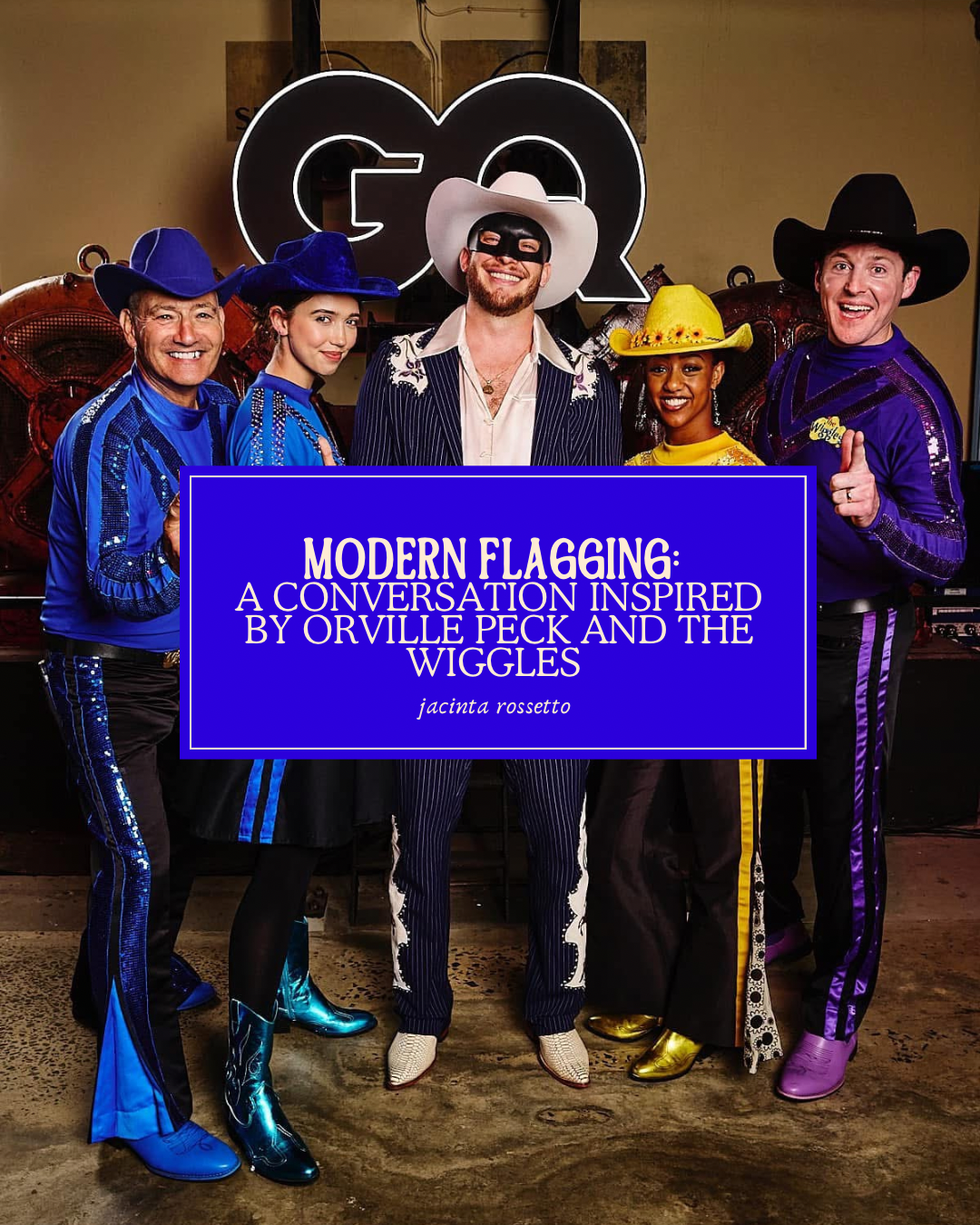
A surprisingly wholesome queer anthem has sprung up from quite an unexpected collaboration in the last couple of weeks. The Wiggles released a country album earlier this year, which includes a song featuring queer country singer, Orville Peck.
The song is called ‘Friends of Dorothy’, an intentional nod to old-fashioned queer slang under the guise of its literal connection to Dorothy, the green dinosaur who is friends with The Wiggles. There are some wonderfully subtle queer lyrics in the song, such as “Well, somеbody asked if we were friends of Dorothy’s and we said ‘Yes, of course’… Anthony’s a friend of her, and Simon is, too. Lachy’s friends with Dorothy, and I’m pretty sure John is, too.”
The term ‘friend of Dorothy’ is a code that was adopted by gay men in the mid 20th century, and refers to the character of Dorothy Gale of ‘The Wizard of Oz’, who was portrayed by Judy Garland, the unofficial mascot for gay men of the 1950’s. This code technique, often referred to as ‘flagging’ allowed for gay men to discreetly communicate with and find other gay men.
The term ‘flagging’ as queer slang, originated in the 20th century with the practice of using colour-coded hankies to wordlessly communicate sexual preferences among the queer community. Like the hanky code, the question ‘Are you a friend of Dorothy?’ would be easily recognisable to others in the community, while simultaneously being completely unnoticeable to straight men. The phrase is a little old-fashioned now and too easily recognisable to be a practical flagging technique, but is a piece of queer history that Orville Peck and The Wiggles have decided to proudly reclaim.
So how has modern flagging in queer culture evolved since ‘friends of Dorothy’ and the hanky code?
With Grindr bringing about the golden age of shameless hookups for gay men, it seems they have outgrown the need for stylistic flagging techniques — glittery thongs don’t exactly fly under the radar — and instead opting for a broad vocabulary of code words to communicate their preferences and identities.
The asexual community has mastered the art of subtle flagging, using practices that easily fly under the radar of inquisitive straights. The use of black rings on the middle finger of the right hand is easily recognisable in the community as a code for asexuality. Ace playing cards are also used to symbolise asexuality, with each suite communicating a different identity; the ace of hearts (romantic asexuality), the ace of spades (aromantic asexuality) the ace of clubs (gray asexuality and gray aromantic), and the ace of diamonds (demiromantic and demisexual).
Some modern flagging techniques for lesbians and sapphics include the recently popularised (and not so discreet) use of carabiners as a fashion statement, not only to denote queerness among women, but also to differentiate between tops (worn on left belt loop) and bottoms (right belt loop). WLW also practice flagging through fingernail art and styles, most commonly shown by painting the middle and ring fingernails different colours to the rest, and/or forgoing acrylic nails on these two fingers (for obvious reasons). Other flagging practices and stylistic choices commonly favoured by lesbians include the growing out of armpit hair (to deter men), thumb rings, eyebrow slits, and septum rings.
Modern flagging has encountered a new problem though; being co-opted by straight people. Many of the stylistic choices adopted by queer people as a way of communicating their sexuality have influenced the straight community, and therefore lost some of their ‘power’ as queer codes. Queerness is still vilified throughout much of the world, but we are living in a strange time where queer culture, style and language bleeds into the mainstream. Where once a septum rings would be enough to signify sapphic tendencies, it has instead become a popular piercing choice for the indie and the alternative, among others.
The queer community is facing a unique problem in the modern world, where they are equally hated and beloved by society. They find themselves objectified and dehumanised in political and religious spheres, but simultaneously heralded as pioneers and influences of arts, culture and fashion.