
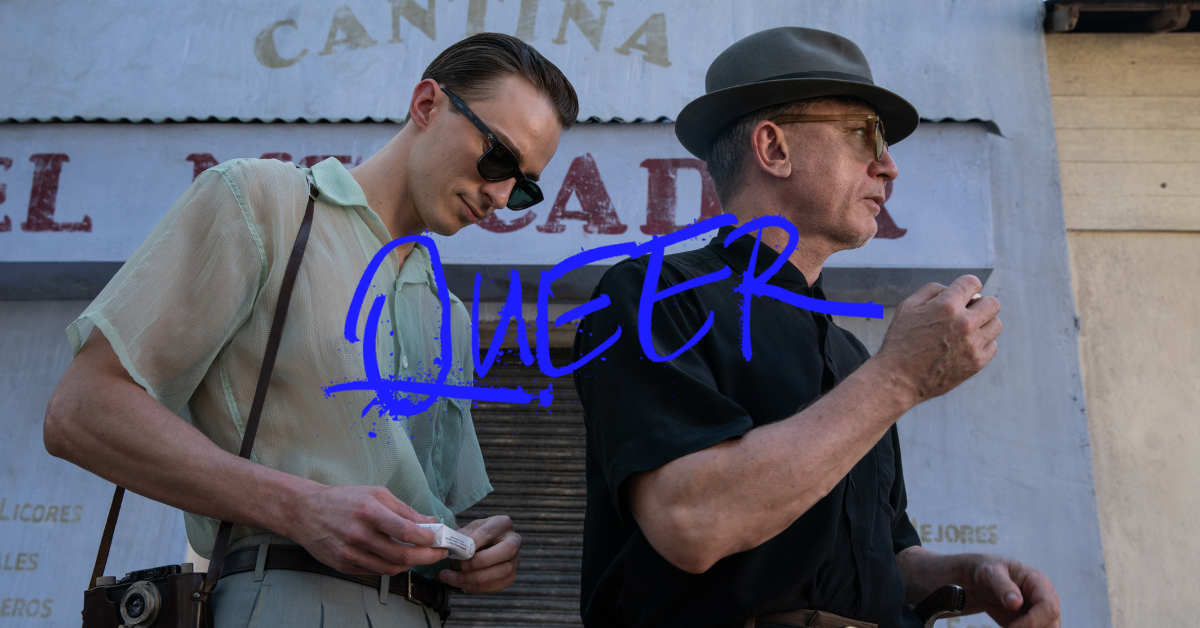
Ahhh, the end of summer. A perfect time for a queer romance to slap you silly and leave you contemplating your sanity for ever wanting to love.
Cue, Queer.
Based on William S. Burroughs’ autobiographical novel of the same name, Queer follows Burroughs’ fictional alter ego, William Lee, as he falls for the coy and enigmatic Oklahoma student Eugene Allerton while wrestling with past transgressions in self-imposed exile.
Directed by Luca Guadagnino (Challengers, Call Me By Your Name, Suspiria) and starring Daniel Craig and Drew Starkey—with a much-publicized (and leaked) performance by Omar Apollo—Queer promised a steamy, sensual gay love story with the intrigue and allure of an A24 film.

I walked into this film knowing nothing about Burroughs, his book, or his cultural impact in America. I was drawn in by Apollo’s acting debut and the film’s contribution to my TikTok algorithm.
I want to preface my review that lately, I’m not in love with queer stories that end in sadness and despair—I’ve had my fair share and crave something different.
But Queer is a product of its time, and history wasn’t always kind to queer people. While the story left me unsettled, I can’t deny that this is a beautifully crafted film.
From the moment we meet William Lee, discomfort takes centre stage. Daniel Craig’s performance is intense, bordering on off-putting, as he stumbles between bravado and aching insecurity. His pursuit of Eugene is relentless, at times desperate, and eerily familiar—how many of us have tried too hard to be seen, to be loved, to be wanted? Craig plays this with a sharp awkwardness that makes Lee feel both pitiful and painfully real.
Drew Starkey’s Eugene is the opposite: distant, unreadable, almost intangable. Their dynamic isn’t built on passion so much as an unspoken, gnawing hunger—for love, for validation, for something neither of them can quite name.

Guadagnino’s direction leans into this discomfort. The film’s dream sequences blur the lines between reality and desire, making the whole experience feel feverish, like a love story on the verge of slipping into a nightmare.
The soundtrack bends time, warping the emotional landscape, making moments feel both immediate and impossibly far away. With inclusions from Nirvana, I was initially left displeased with modern music bleeding into this historical romance, but after finding out the connection between Burroughs and Kurt Cobain, it felt like a meaningful choice.
“I Am Disembodied”
One of the film’s most striking lines comes from William and then later Eugene: “I am not queer, I am disembodied.”
A line encapsulating the division of mind and body in the queer experience
Their bodies want, but their minds won’t let them have. And that’s the tragedy of Queer. It’s a film about love starved of connection, about queerness wrapped so tightly in shame that it can’t be fully realised.
The film’s ending deviates from Burroughs’ novel, which leaves William and Eugene in the jungle, chasing a vision they never reach. Here, screenwriter Justin Kuritzkes reshapes the story’s conclusion, but the core remains: Lee is robbed of his love story—not just by Eugene’s disinterest, but by the time, by his own inability to let go.
For some, this will be a frustrating watch. Another queer story that feels more like a ghost story, another romance where love is just out of reach. But for what it is—a melancholic, atmospheric, and deeply uneasy portrait of longing—Queer succeeds.
It won’t leave you wanting to hold a lover tighter, but it will stay with you.
